


Written by Rebekah Kim, M.A.
One challenge in improving quality of life for patients and loved ones affected by KIF1A Associated Neurological Disorder (KAND) is that there are not always clear-cut answers for symptom management. While we don’t have all the answers, we’ve gathered some resources on urinary and bladder symptoms in KAND that you can discuss with your doctor when making decisions about care.
When discussing the impact of KAND symptoms, it’s crucial to acknowledge their impact on quality of life. Urinary and bladder symptoms aren’t solely a medical issue – they can also have effects on socialization, self-confidence, and family logistics for travel, recreation, school, and work.
These symptoms are commonly discussed in the KAND community, but what do we know about these symptoms and how they relate to KIF1A?
Causes of urinary and bladder symptoms in KAND
In KAND, changes in KIF1A can affect the nervous system and the way nerve signals are communicated throughout the body. One part of the nervous system that may be affected is the automatic nervous system (ANS), which controls many body functions that happen automatically without us having to think about them. These include heart rate, blood pressure, breathing, digestion, sweating, body temperature, and bladder function.
When these signaling changes involve the ANS, they may contribute to symptoms of autonomic dysfunction, or dysautonomia. Symptoms vary and may include dizziness or fainting when standing, constipation, difficulty regulating body temperature, changes in sweating, bladder or bowel problems, abnormal heart rate or blood pressure, brain fog, and fatigue.
Bladder function is one area that can be affected by changes in the nervous system. Normally, the brain, spinal cord, and nerves work together to signal when the bladder should store urine and when it should empty. When these signals are disrupted, the bladder may not fill, hold, or empty urine normally. This type of nervous system-related bladder problem is known as neurogenic bladder, a condition that affects bladder control due to problems with the nervous system.
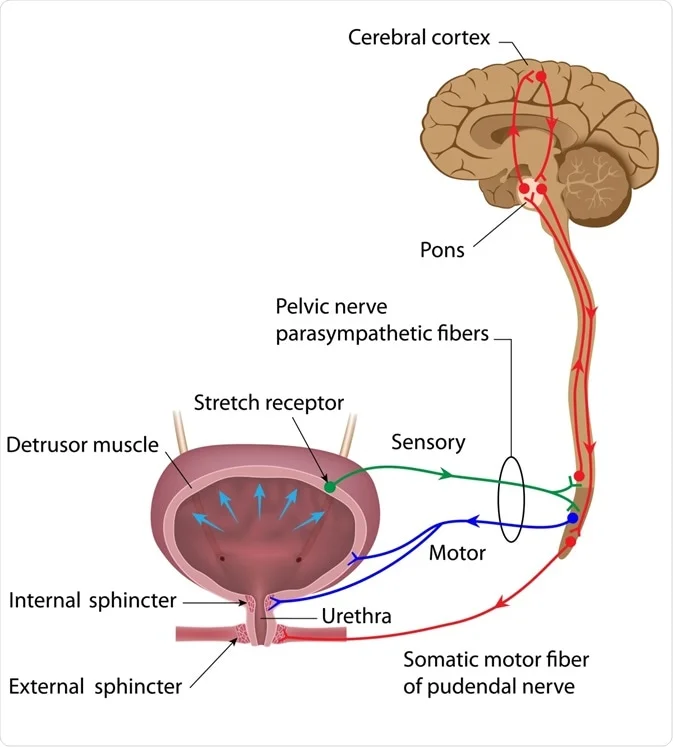
In individuals with KAND, neurogenic bladder can occur because changes in the nervous system affect communication between the bladder and the brain. Symptoms vary and may include frequent urination, difficulty emptying the bladder completely, urinary retention, urinary incontinence, recurrent urinary tract infections (UTIs), or leakage between bathroom visits
Symptom types
- Urinary Tract Infection (UTI): A bacterial infection that affects any part of the urinary system, including the kidneys, bladder, ureters, or urethra. People with neurogenic bladder may be at higher risk because urine that remains in the bladder provides an environment where bacteria can grow. Symptoms may include pain or burning during urination, frequent urination, cloudy or foul-smelling urine, fever, abdominal pain, or changes in behavior or alertness, especially in young children. Kidney infections have been a cause for hospitalization in KIF1A patients.
- Hydronephrosis: A condition in which one or both kidneys become swollen when urine cannot fully empty from the body. When urine backs up, it can stretch the kidneys and damage kidney tissue if left untreated over time. Symptoms may include sudden or intense pain in the side or back, vomiting, painful urination, blood in urine, or urinary tract infections (UTIs).
- Spastic/Overactive Bladder: A condition in which the bladder contracts more often than it should, creating a sudden and frequent need to urinate. Symptoms include a sudden need to urinate, frequent urination, urination due to unrelated behaviors like laughing, waking up multiple times at night to urinate, and an urgent need to urinate followed by an involuntary leakage of urine.
- Spastic Bladder Outlet Obstruction: Occurs when the muscles around the bladder outlet and urethra fail to relax properly during urination. Instead of opening to allow urine to flow freely, these muscles remain tight or contract at the wrong time, making it difficult to empty the bladder. Symptoms may include difficulty starting urination, recurrent urinary tract infections (UTIs), a weak urine stream, or feeling that the bladder is not empty.
- Urinary Incontinence: The loss of bladder control, resulting in accidental leakage of urine. Symptoms can range from occasional leakage to frequent accidents and may occur during physical activity, after a sudden urge to urinate, or without warning.
- Urinary Retention: The inability to completely empty the bladder. In some cases, a person may not be able to urinate at all, while others may still be able to urinate but leave urine behind in the bladder. Symptoms include difficulty starting urination, a weak urine stream, a feeling that the bladder is still full after using the bathroom, lower abdominal discomfort, or recurrent urinary tract infections.
- Vesicoureteral Reflux (VUR): Urine flows backward from the bladder toward the kidneys instead of leaving the body. This can happen when the valve between the bladder and ureters does not close properly. Repeated episodes of reflux may increase the risk of kidney infections and kidney damage over time. Symptoms may include recurrent urinary tract infections (UTIs), fever, pain in abdomen or lower back, or kidney problems, although some people have no obvious symptoms.
- Double Collecting System: When a kidney has two drainage systems linking to the bladder. This is often harmless, but may increase risk of infections in patients who are already susceptible.
Visiting your Urologist or Nephrologist
What information should I provide about KAND?
- KAND is a progressive developmental and neurodegenerative disorder with impacts throughout the nervous system
- KIF1A mutations cause spasticity, hypotonia, and peripheral neuropathy, all of which may impact urinary and bladder function
- Urinary symptoms may become more prevalent in adolescence and early adulthood
- KAND patients are uniquely vulnerable to infections: Urinary tract and kidney infections are a common risk
- Infections can have severe consequences for KAND patients, resulting in worsening of other symptoms or complications that require emergency care
How is neurogenic bladder evaluated?
Urodynamic testing is a group of tests that measure how well the bladder and urethra store and release urine. These tests help doctors understand whether bladder problems are caused by the muscles, nerves, or both
References
[1] Okamoto, N., Miya, F., Tsunoda, T., Yanagihara, K., Kato, M., Saitoh, S., Yamasaki, M., Kanemura, Y., & Kosaki, K. (2014). KIF1A mutation in a patient with progressive neurodegeneration. Journal of human genetics, 59(11), 639–641. https://doi.org/10.1038/jhg.2014.80
[2] Montenegro-Garreaud, X., Hansen, A. W., Khayat, M. M., Chander, V., Grochowski, C. M., Jiang, Y., Li, H., Mitani, T., Kessler, E., Jayaseelan, J., Shen, H., Gezdirici, A., Pehlivan, D., Meng, Q., Rosenfeld, J. A., Jhangiani, S. N., Madan-Khetarpal, S., Scott, D. A., Abarca-Barriga, H., Trubnykova, M., … Gibbs, R. A. (2020). Phenotypic expansion in KIF1A-related dominant disorders: A description of novel variants and review of published cases. Human mutation, 41(12), 2094–2104. https://doi.org/10.1002/humu.24118
[3] Kawashima, A., Kodama, K., Okubo, Y., Endo, W., Inui, T., Ikeda, M., Katata, Y., Togashi, N., Ohba, C., Imagawa, E., Iwama, K., Mizuguchi, T., Kitami, M., Aihara, Y., Takayama, J., Tamiya, G., Kikuchi, A., Kure, S., Saitsu, H., … Haginoya, K. (2024). Long-term clinical observation of patients with heterozygous KIF1A variants. American Journal of Medical Genetics Part A, 194A:e63656. https://doi.org/10.1002/ajmg.a.63656
[4] Krenn, M., Zulehner, G., Hotzy, C., Rath, J., Stogmann, E., Wagner, M., Haack, T. B., Strom, T. M., Zimprich, A., & Zimprich, F. (2017). Hereditary spastic paraplegia caused by compound heterozygous mutations outside the motor domain of the KIF1A gene. European journal of neurology, 24(5), 741–747. https://doi.org/10.1111/ene.13279
[5] Lin, Q., Verden, D., Christodoulou, J. et al. KIF1A-associated neurological disorders: therapeutic opportunities and challenges. Eur J Hum Genet (2025). https://doi.org/10.1038/s41431-025-01978-8
[6] Chung W, Boyle L. KIF1A-Related Neurodevelopmental Disorder. 2026 Apr 2. In: Adam MP, Bick S, Mirzaa GM, et al., editors. GeneReviews® [Internet]. Seattle (WA): University of Washington, Seattle; 1993-2026. https://www.ncbi.nlm.nih.gov/books/NBK621569/
[7] Marra, J.M., de Castro Vieira, P.V., de Senna Migueletto, A.M. et al. Neurogenic Disorders and the Lower Urinary Tract Dysfunction: Proposed Approach for the Gynecologist. Reprod. Sci. 30, 2087–2091 (2023). https://doi.org/10.1007/s43032-023-01213-z
Rebekah Kim, M.A.
Rebekah Kim is a volunteer with the KIF1A community and a biotechnology graduate student with a deep interest in genetic disorders and patient-centered research. Coming from a background rooted in molecular biology, she is driven by a desire to support rare disease communities, strengthen communication between researchers and patients, and contribute to efforts that bring clarity, compassion, and hope to those affected by KAND.